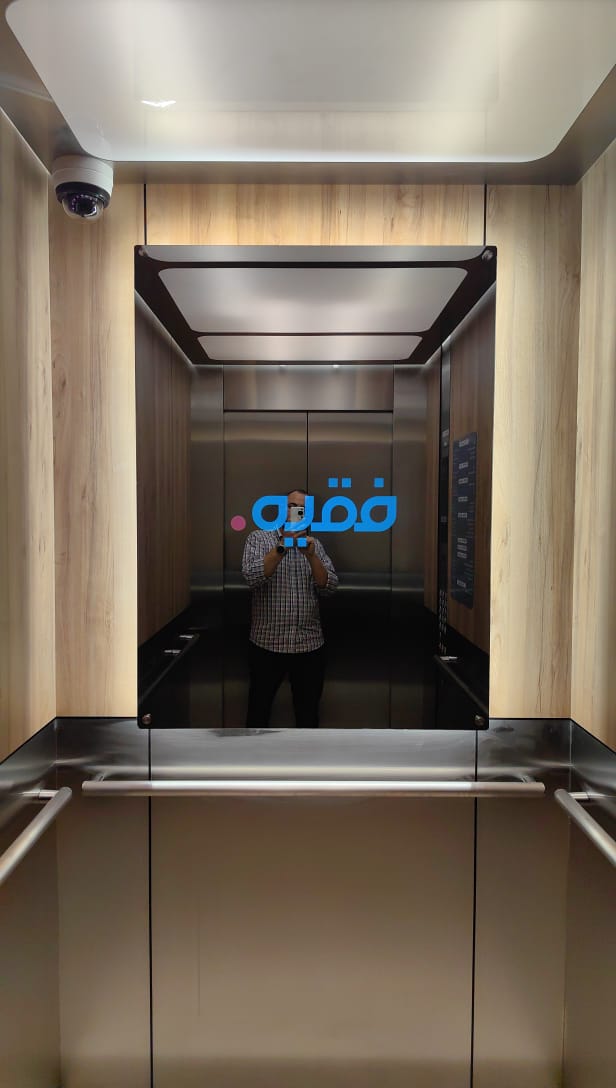


Smart mirrors improve the hospital patient experience by turning elevator cabins and lobby surfaces into contextual information screens — showing wayfinding, department directories, prayer times, waiting-time updates and health information in Arabic and English, during the twenty to forty seconds a patient is already standing still and looking at the mirror.
Ask a patient what makes a hospital visit stressful and very little of the answer is clinical. It is not knowing which floor the department is on. Not knowing whether you are late. Not knowing how long the wait will be. Walking corridors that all look identical while holding a paper slip with a room number on it.
Hospitals invest heavily in clinical quality and then lose patient satisfaction points to problems that are, at root, information design. Signage helps, but static signage cannot tell you that your department moved to the third floor last month, or that the clinic you are heading to is running forty minutes behind.
There is a peculiar property to vertical transit that makes it the most underused communication space in any hospital.
A patient in a corridor is walking, distracted, and navigating. A patient in a waiting room is anxious and often on their phone. But a patient in an elevator is stationary, undistracted, and frequently without mobile signal, for twenty to forty seconds, several times per visit. They are already looking at the mirror.
That is not a marketing observation. It is the only moment in a hospital journey where you have someone's uninterrupted attention without competing for it.
Wayfinding at the decision point. Floor-by-floor department directories displayed as the cabin approaches each level. Patients arrive at the right floor rather than discovering they are wrong two corridors later.
Live operational information. Connected to building and clinic systems, the mirror can surface current waiting times, clinic delays and department announcements — replacing the reception desk queue that exists purely to answer "how long?"
Arabic and English, natively. Right-to-left rendering and Arabic scheduling built in rather than bolted on. In Saudi hospitals serving both local and expatriate populations, information that only exists in one language is information half the building cannot use.
Prayer times and orientation. Practical, culturally relevant content that a generic international signage product does not handle well.
Health and preventive information. Seasonal vaccination reminders, screening programmes, departmental health education — delivered to a genuinely captive audience rather than a leaflet nobody picks up.
Emergency and operational messaging. Integrated with building management systems, the same surface carries evacuation instructions or urgent notices to everyone in transit.




The privacy question, answered directly
Any camera-adjacent technology in a hospital deserves scrutiny, so the answer should be unambiguous: a well-designed smart mirror does not identify individuals. Sensing reads anonymised aggregate signals — whether someone is present, broad audience characteristics, time of day — to decide which content is relevant. No personally identifiable imagery is stored or transmitted.
That distinction matters in healthcare more than anywhere. A system that cannot identify a patient cannot leak a patient's identity, and any vendor unwilling to state that plainly should be asked why.
What it does for the hospital, not just the patient
Patient experience scores are increasingly tied to funding, accreditation and reputation. But the operational case is simpler: every question answered by a screen is a question not asked at a reception desk. Wayfinding, waiting times and department locations are the three highest-volume reception queries in most facilities.
There is also an asset argument. A hospital with a large lift bank has a communication channel reaching every patient, visitor and member of staff, several times per visit, with no app to download and no mailing list to join.
Frequently asked questions
Does installing a smart mirror require replacing the elevator?
No. Units are designed to retrofit into existing cabins, replacing or overlaying the existing mirror panel, typically within a single working day per cabin and scheduled around clinical operations.
Can it show live waiting times?
Yes, where the hospital's systems expose that data. Integration with building management and clinic systems is what separates a smart mirror from a screen playing a loop.
Is it hygienic in a clinical environment?
The surface is sealed glass with no touch interaction required, so it cleans exactly like a standard mirror and introduces no additional contact point.
Does it work without network connectivity?
Content is cached locally, so the display keeps operating during an outage and reconciles reporting once connectivity returns — relevant in deep-shaft installations and basement levels.
Does it comply with Saudi data privacy regulation?
Processing is designed around anonymised aggregate signals with no personally identifiable data retained, which is the basis on which it can be deployed in regulated healthcare environments.
Where to start
Start with the lift bank serving your busiest outpatient department, and measure two things over a quarter: reception query volume on wayfinding and waiting times, and your patient experience scores for the same period. Those are the numbers that will tell you whether it earned its place.
You can read more about the AINA smart mirror platform, how it applies across healthcare facilities, or speak to our team in Jeddah.