


A Matterport virtual tour is a navigable 3D digital twin of a real space, captured with a scanning camera and published as a browser-based walkthrough with accurate measurements and a dollhouse overview. In Saudi real estate it is used to market completed inventory remotely and, alongside 3D renders, to help buyers understand off-plan units before construction finishes.
Across the UAE and Saudi Arabia in 2026, static presentations are no longer enough. Serious buyers expect to see and move through a project long before construction finishes, usually from a phone or a laptop, and often before they will agree to a site visit at all.
The commercial problem this solves is not really about presentation quality. It is about wasted viewings. A sales team that runs twenty physical viewings to close two deals is spending most of its week on buyers who could have self-selected out in ninety seconds online. A walkable tour moves that filtering to the top of the funnel.
For developers marketing to buyers outside the Kingdom — a growing share of demand around Riyadh and the Red Sea projects — it removes the geography problem entirely.
Renders and virtual tours are often discussed as if they compete. They do not; they answer different questions.
A render answers "what will this look like?" It is an artistic interpretation, produced before anything is built, and it is inherently flattering.
A Matterport scan answers "what is actually here?" It captures a real space with real proportions. A buyer can walk the circulation, look at the ceiling height above the stairwell, check what the second bedroom window actually faces, and measure the kitchen wall to see whether their existing units will fit. Measurement accuracy is typically within a small tolerance, which is enough for fit-out planning.
Sophisticated buyers can tell the difference, and the shift toward digital twins is partly a trust response to years of renders that flattered the finished product.
The obvious objection is that you cannot scan a building that does not exist yet. That is true, and it is why serious off-plan programmes use a combined approach.
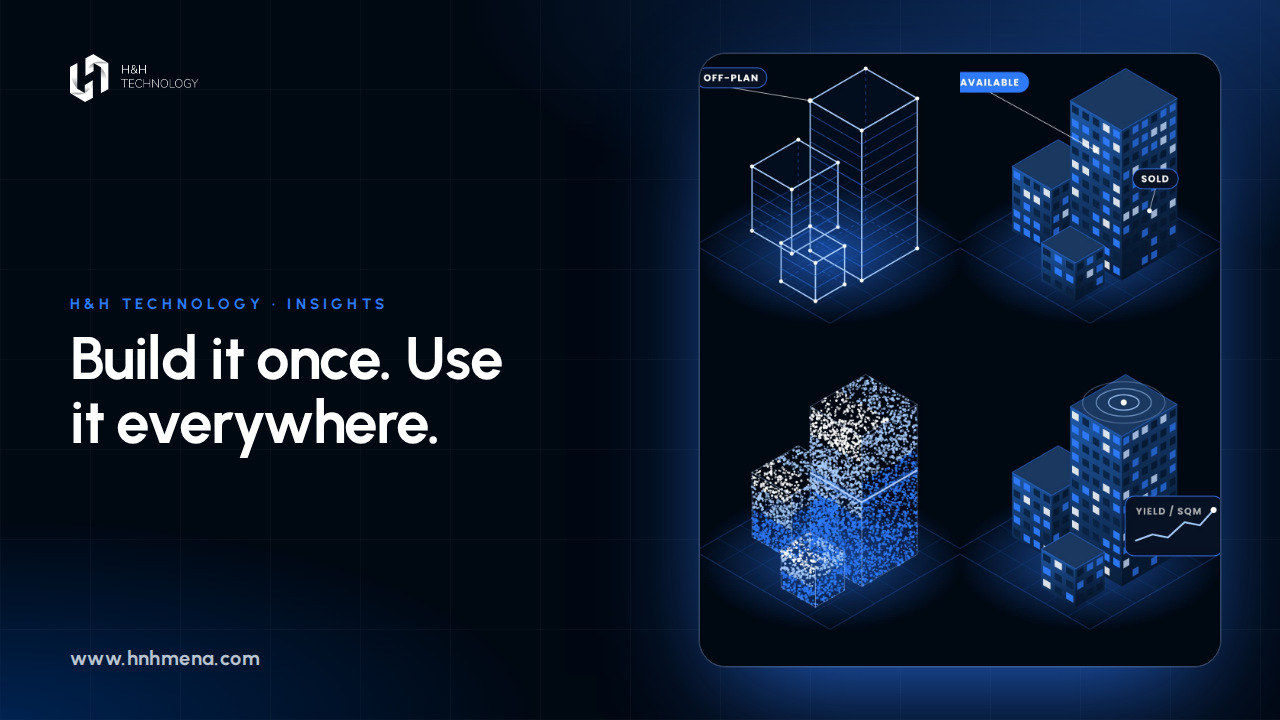
Developers scan the show unit or a completed comparable unit from an earlier phase, then pair that navigable tour with 3D renders and an interactive configurator for the specific unit being sold. The buyer walks a real space to understand scale and flow, then uses the configurator to see their own layout, finish package and view.
This sequence works because it separates the two things a buyer needs. Scale and spatial feel come from the real scan. Personalisation comes from the configurator. Asking a render alone to carry both is where most off-plan marketing loses the buyer.
Once a phase completes, those units get scanned too, which builds a reusable library for resale and leasing rather than a one-off campaign asset.





Beyond real estate
The same capture technology carries into other sectors we work with in Saudi Arabia. Hotels and resorts publish tours of room categories, ballrooms and event spaces so corporate planners can assess suitability without a site inspection. Hospitals and clinics use them for wayfinding and pre-visit familiarisation, which measurably reduces anxiety for first-time patients. Universities publish campus tours for international applicants. Facility managers keep an accurate as-built record for maintenance and insurance.
In every case the underlying value is the same: an accurate spatial record that anyone can access without travelling.
Frequently asked questions
How long does a Matterport scan take?
A typical residential unit takes two to four hours on site. Larger properties such as hotels or hospital floors are scheduled across multiple days. Processing and publishing usually completes within a few working days.
Does the property need to be furnished?
It scans either way, but furnished spaces perform noticeably better commercially because buyers judge scale against objects they recognise.
Can virtual tours be embedded on our own website and portals?
Yes. Tours embed on your site, can be shared as a direct link for WhatsApp and email, and work on mobile browsers without an app.
Do virtual tours help SEO?
Indirectly but meaningfully. They substantially increase time on page and reduce bounce rate, both of which correlate with ranking performance, and property pages with embedded tours tend to attract more inbound links.
What does a virtual tour cost in Saudi Arabia?
Pricing depends on floor area, number of units and whether renders or configurators are bundled. Per-unit cost falls sharply across a multi-unit development, so scanning a full phase is generally far more economical than scanning one villa.
Getting started
The most useful first step is to scan one unit you are actively selling and measure what changes — enquiry quality, viewing-to-offer ratio, time on page. That gives you an honest number for your own market rather than a vendor's benchmark.
You can read more about our Matterport virtual tour service, see how it pairs with 3D architectural renderings, or speak to our team in Jeddah about a specific development.