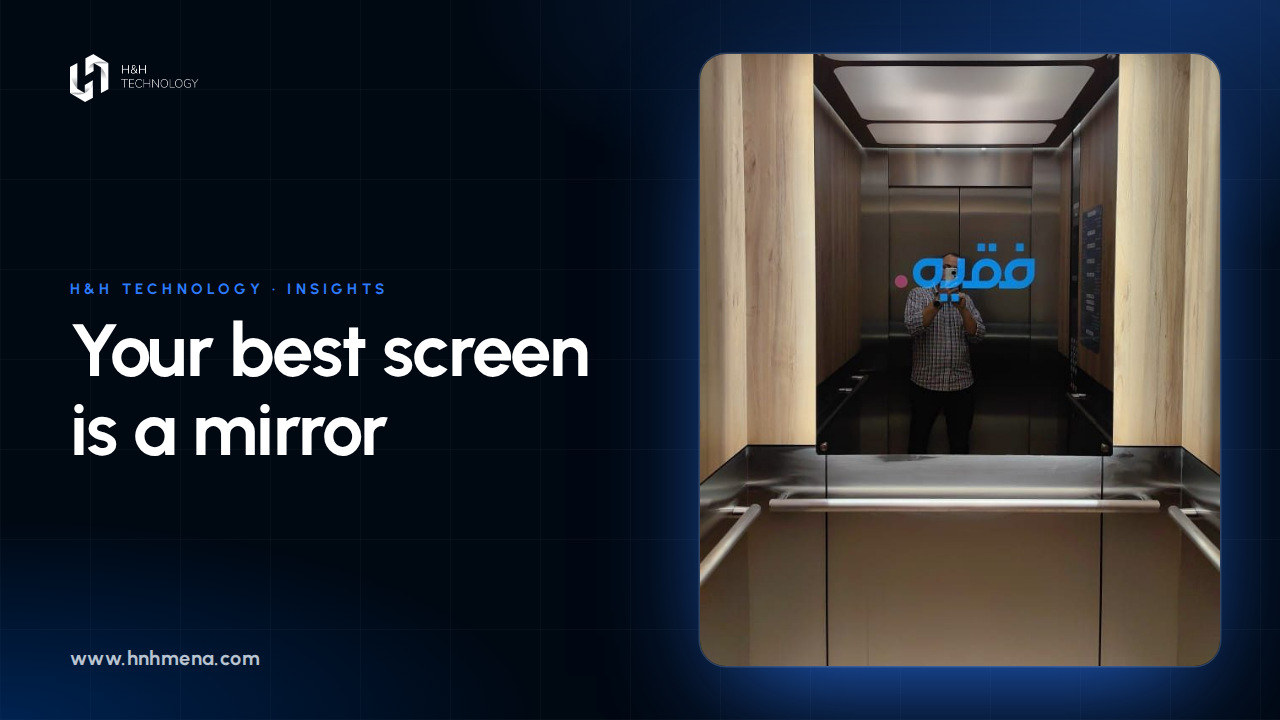


“Is this an antique, or just today’s elevator without the facelift?” That is the question H&H Technology puts to building owners in its AINA deck, and it is a fair one. The lobby has been redesigned twice and the app has been rebuilt, yet the lift cabin looks the way it did the day it was installed.
It is also the one place in the building where people stand still and face the same wall. Elevator advertising in Saudi Arabia starts from that simple fact. This article explains why the lift is a strong media space, why a smart mirror beats a bolted-on screen, and what to check before you install anything.
Key takeaways
Start with the numbers in the AINA deck: more than 1 billion lift rides every year in KSA, and 20 to 60 seconds per trip. The deck describes that time as 100% distraction-free engagement.
Compare that with every other screen. DataReportal’s Digital 2026 report counts 34.4 million internet users in Saudi Arabia, 99.0% of the population. Almost everyone who enters your building carries a screen that competes with yours.
In the lift, the contest is more even. The ride is short, and the passenger is facing the wall you own. Most people already look at the mirror. The question is what the mirror does with that attention.
The usual approach to lift digital signage, in KSA and elsewhere, is familiar. A standard display is fixed to the cabin wall and loops a playlist.
It looks added, because it was. When the screen is off or the content is weak, a framed black rectangle is a dead panel in a premium space. It also competes with the mirror rather than using it.
AINA takes the opposite approach. It is a polished architectural mirror with a commercial-grade display behind the glass. With the screen off, it is a premium mirror. With the screen on, it shows launches, amenities, wayfinding and notices. There is no bezel.
H&H sums it up in one line: mirror when idle, media when it matters.
H&H frames the owner’s case in three verbs.
Sell. Promote your launches to residents and visitors who are already in your towers. H&H’s line for this is “every lift, a showroom”.
Serve. Publish building notices, amenity updates and events on the mirror, with no printed flyers taped to the cabin wall.
Earn. Sell screen time to retail tenants and partner brands, who want the attention of the people upstairs.
Finishes are frameless, stainless-steel frame or flush-mounted. AINA integrates with all major elevator brands.
Hardware is half the product. The other half is who controls the content.
AINA has a built-in cloud CMS. Content is scheduled centrally by screen, by building or by time of day. Arabic and English run from one dashboard. Layouts can be landscape or portrait, with multiple content zones on one surface.
In practice, an owner can show a launch film in one tower, a maintenance notice in another, and a tenant’s breakfast offer in the morning only.
Beyond scheduled media, AINA can show live information: weather, news, building events and targeted ads. It is multilingual. It also offers AI personalisation, with one note from H&H: advanced features vary between AINA Basic and AINA Plus, so confirm which tier covers what you need.
The Interactive Series adds two things to the mirror. The first is RGB lighting that changes by theme or by floor. The second is touch- and hover-sensitive surfaces.
It suits places where the lift or the wall is part of the experience, such as a flagship tower or a sales gallery.
AINA is deployed across elevators, lobbies, sales galleries, show units and homes. It is also proven in live hospital lift deployments.
The Residential model brings the same idea into the house. H&H describes it as “the face of AI on the one screen you already look at every day”.
From sign-off to live takes 3–4 weeks. The process has four steps:
After go-live, H&H provides local KSA support, annual maintenance (AMC) and a CMS subscription. Local manufacture and local support matter for a product that sits inside a lift.
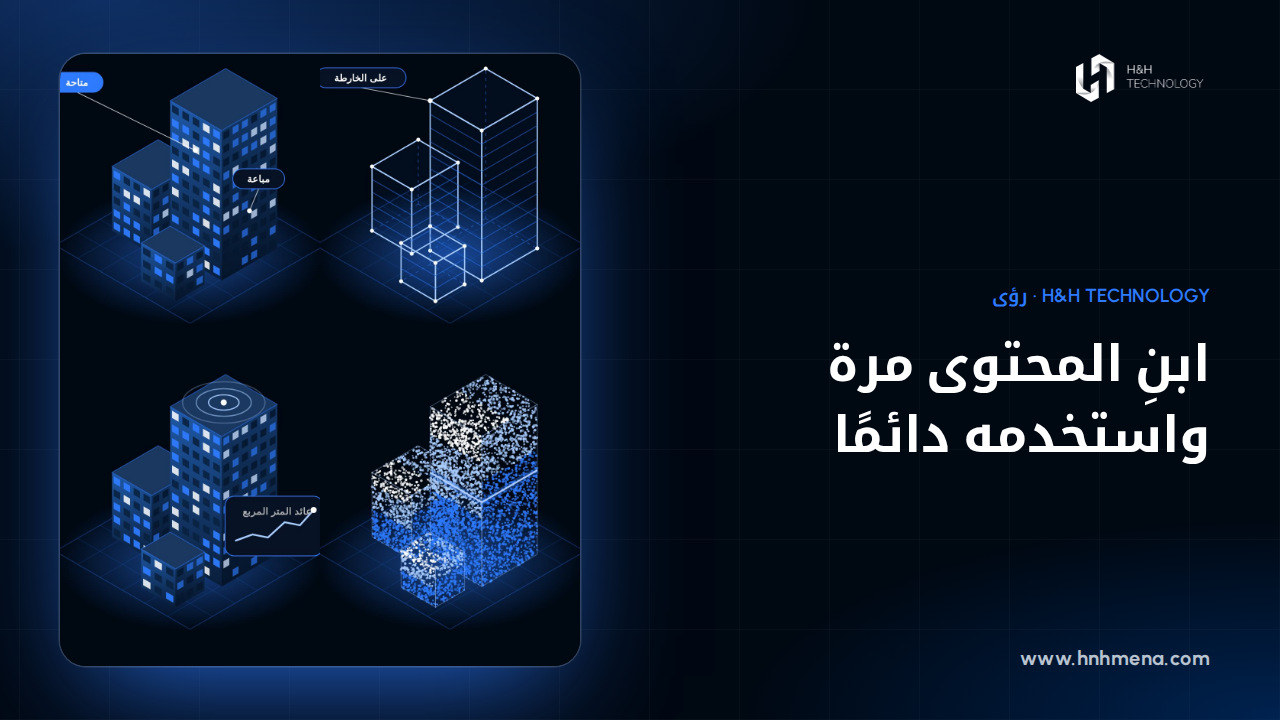
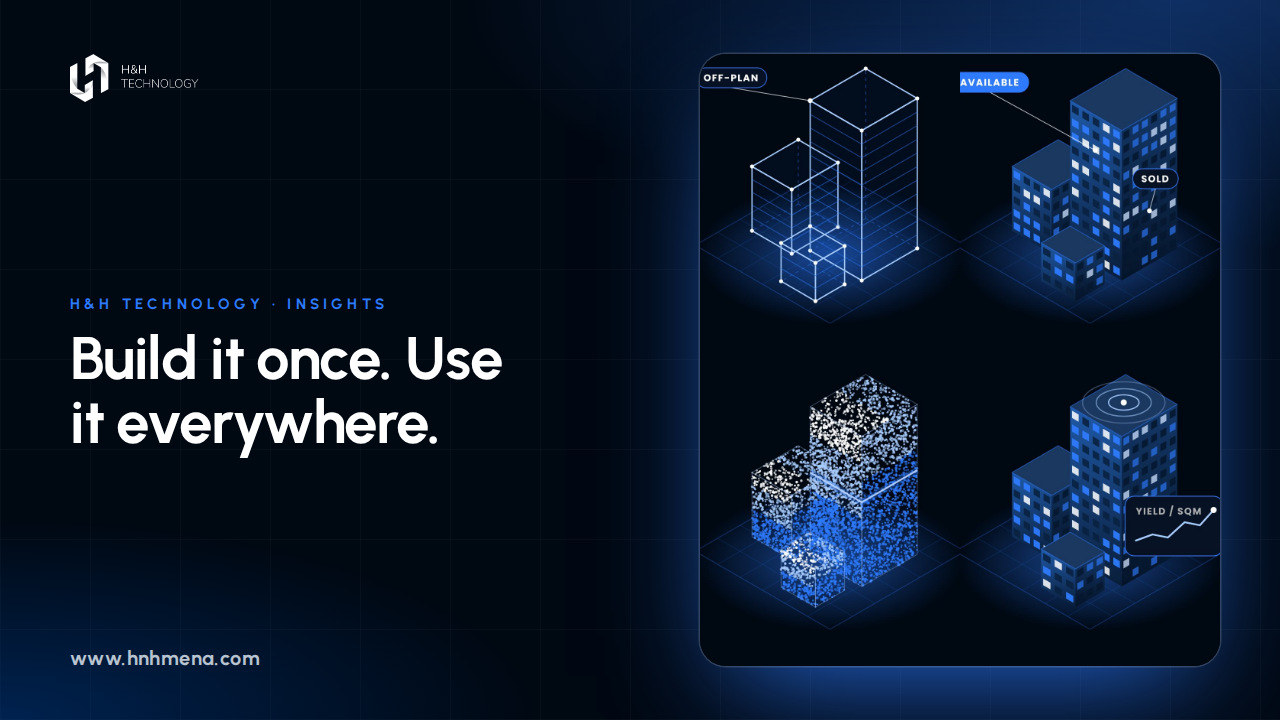
In H&H’s developer lifecycle, AINA belongs to the operate stage. The launch stage is Ultrascape, the 3D configurator for off-plan sales. Handover is recorded with a LiDAR digital twin.
Content built for a launch can play on the mirrors in towers you have already delivered, alongside your website and app. The full range is in the AINA section of hnhmena.com.



FAQ
What is an AINA smart mirror?
AINA is a Saudi-made smart mirror: a polished architectural mirror with a commercial-grade display behind the glass. When the screen is off it is a premium mirror with no bezel. When it is on, it shows launches, amenities, wayfinding and notices, scheduled from the AINA cloud CMS in Arabic and English.
Will AINA work with my existing lifts?
AINA integrates with all major elevator brands. The Mini model is made for passenger and service lifts, the Maxx for flagship lifts, and custom sizes are built as required. Finishes are frameless, stainless-steel frame or flush-mounted. The process begins with a site survey, so fit is confirmed before fabrication.
How long does it take to install AINA?
From sign-off to live takes 3–4 weeks. The steps are a site survey, design and fabrication in KSA, installation, and go-live. After that, H&H provides local KSA support, annual maintenance under an AMC, and a CMS subscription for the cloud dashboard.
Can I earn revenue from elevator screens in my building?
Yes. H&H’s “Earn” model is for owners to sell screen time to retail tenants and partner brands. The cloud CMS schedules content by screen, building and time of day, so a tenant’s offer can run only in the relevant tower and only at the hours when it is useful.
Related reading
Talk to the team
To discuss your lifts, lobbies or show units, speak to the AINA team at H&H Technology. Message Salman Alamoudi, Business Development, on WhatsApp at https://wa.me/966506176388, or Hamza Mohammed, Pre-Sales & Finance Associate, at https://wa.me/966557203084. You can also use the contact section on hnhmena.com.
Sources